
unSpoken - Feat. Chipo Mukoki
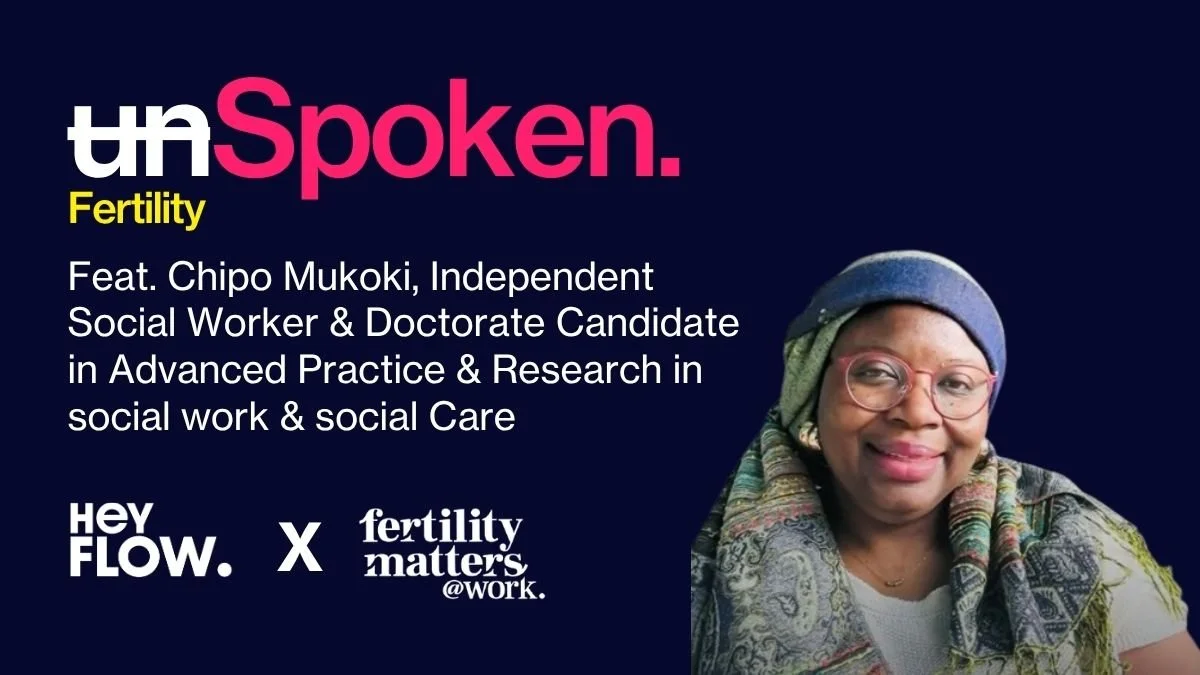
As part of this special edit of HeyFlow’s unSpoken series in collaboration with Fertility Matters at Work, we caught up with Chipo Mukoki, Independent Social Worker & Doctorate Candidate in Advanced Practice & Research in social work & social Care.
unSpoken by HeyFlow is a series of interviews about the reproductive health penalty on women’s careers. We’re on a mission to show that reproductive health isn’t just a women’s issue — it’s a business issue.
During Infertility Awareness Month, we are featuring real stories about the impact of fertility on women in the workplace.
Please introduce yourself and tell us a bit about your current role.
Chipo: My name is Chipo Mukoki. I am a Zimbabwean/British independent social work leader, child rights advocate, Doctorate researcher and a champion for fertility inclusion in the workplace across the children and families social work sector in England.
I have worked in children's social work practice and leadership in the UK for almost twenty years, supporting children and families through some of the most difficult moments of their lives. Alongside my professional career, I have lived with infertility and fertility treatment, experiences that have profoundly shaped both my personal life and my professional thinking.
My current doctoral research explores how Black people of Southern African descent experience infertility and assisted reproduction in the UK.
Alongside this, I am developing work around fertility issues at work, highlighting fertility as an important practice, workforce wellbeing and organisation/business issue, particularly within emotionally demanding professions such as children’s social work.
Can you share the fertility journey or fertility-related moment(s) you had to navigate while working?
Chipo: Much of my fertility journey unfolded while I was working as a frontline child protection social worker and continued for several years into leadership roles.
There were mornings when I would begin the day having blood tests or fertility appointments before arriving at work to make life-changing decisions about children's safety and care. I was navigating invasive medical procedures, failed fertility treatment and the growing realisation that I might never become a mother, while continuing to support children and parents experiencing crisis, loss and trauma and making life changing child protection decisions.
What made the experience especially difficult was that most of the time almost nobody at work knew what I was carrying. Outwardly I appeared competent, calm and dependable. Privately, I was grieving the children I had imagined having while trying to remain fully present for the families I worked with.
Looking back, I realise I wasn't simply balancing two parts of my life as they constantly intersected and entangled. My fertility journey shaped how I experienced my work as a social work practitioner, just as my work shaped how I experienced infertility.
How did this fertility experience impact you at work at the time — professionally, emotionally, or practically?
Chipo: Professionally, I worked incredibly hard to ensure my personal experience did not compromise my judgement. In many ways, it deepened my empathy and my capacity to understand child protection risk, grief, uncertainty and hope. However, at times, I worried about risk of over empathising with parents losing their children or being punitive or harsh.
Emotionally, it was exhausting. Fertility treatment is physically demanding, but the emotional labour of carrying invisible grief or feelings of envy, guilt, shame while supporting other people's trauma is something we rarely acknowledge in social work.
Practically, there were unpredictable bouts of incapacitating period pain, frequent medical appointments, procedures that were difficult to schedule around work and days when I was physically and emotionally depleted but still expected to perform at my usual level.
The greatest challenge was not simply the treatment itself, it was pretending everything was normal. I learned to become very good at hiding what I was going through because there seemed to be no language, policy or workplace culture that recognised fertility as something employees might need support with.
What has been your greatest challenge in sustaining your career during your fertility journey?
Chipo: The greatest challenge was sustaining both my professional identity and my sense of self.
Children and families social work is a profession built around supporting children, their families and parenting. Yet, I was quietly grieving the possibility that I might never have my own family in the way I had imagined. I often felt there was an unspoken expectation that I should simply leave my personal experience at the office door. But infertility doesn't stay outside the workplace. It travels with you into meetings, court hearings, adoption panels, supervision and conversations with colleagues.
As a Black African woman, there was an additional layer. I was already navigating assumptions linked to race, migration and professional identity. Admitting vulnerability or repeatedly requesting time off for fertility treatment felt risky. I worried about being seen as less capable at a time when I was working hard to establish my professional credibility.
Maintaining my career therefore became an exercise in carrying an invisible burden while continuing to practice, lead, make difficult decisions and care for others.
When you were going through this fertility challenge at work, what was the one thing that helped you most — or what do you wish had been in place?
Chipo: What I needed most was simply for someone to stay in the conversation with me.
At one point, when I shared with a supervisor that I had just been told our fertility treatment had failed and we needed a donor, they responded kindly and sympathetically. But we never spoke about it again. The silence that followed was perhaps harder than the conversation itself.
I didn't necessarily need someone to fix the situation. Fertility isn't something colleagues can solve. What I needed was ongoing acknowledgement that this was a significant life event with emotional, physical and practical consequences.
Another supervisor often said, ‘I wonder how you do this work without children of your own’. I never knew whether to take this as a complement, pity or a judgement that maybe my being childless somehow undermined my professional capacity as a social worker.
I wish there had been managers who understood the demands of fertility treatment, policies that recognised fertility appointments without making people feel guilty, reflective supervision that allowed space to think about the emotional impact and my practice, and workplace cultures where infertility could be spoken about without embarrassment or stigma.
Sometimes the most supportive thing a social work employer can do is simply make it safe for people not to carry the experience alone.
What do you believe should be the top priority for employers who want to better support employees through fertility journeys or fertility-related challenges?
Chipo: The starting point is recognising that fertility is a workplace issue, not simply a private issue.
People experiencing fertility challenges are often among your highest-performing employees because they work incredibly hard to ensure their personal struggles remain invisible. But invisibility comes at a cost.
Social work employers need more than a fertility policy and procedures. They need compassionate leadership, informed supervisors and managers and workplace cultures where people feel psychologically safe enough to say, "I'm going through fertility treatment," and ‘‘I am struggling with my mental health or with balancing fertility challenges with work demands’’ without fearing judgement or damage to their career. Social Work practitioners also need supervisors who can challenge them towards reflective practice thinking when their ‘vulnerable self’ may risk compromising their professional judgements.
This means providing flexibility for appointments, training managers to have confident and compassionate conversations, recognising fertility loss alongside other significant life events, and creating spaces where employees can access support before they reach crisis and be supported to make safe practice decisions.
Ultimately, supporting fertility at work in children’s social work is about recognising our shared humanity. When organisations acknowledge that employees bring their whole lives not just their job titles to work, everyone benefits. Staff feel valued, they stay healthier, workplaces become more compassionate, inclusive and sustainable and there is room for good reflective practice and service delivery to the children and families we work with.
At HeyFlow we help organisations remove the blindspots that stall women’s careers, feed the gender pay gap and weaken the leadership pipeline.