
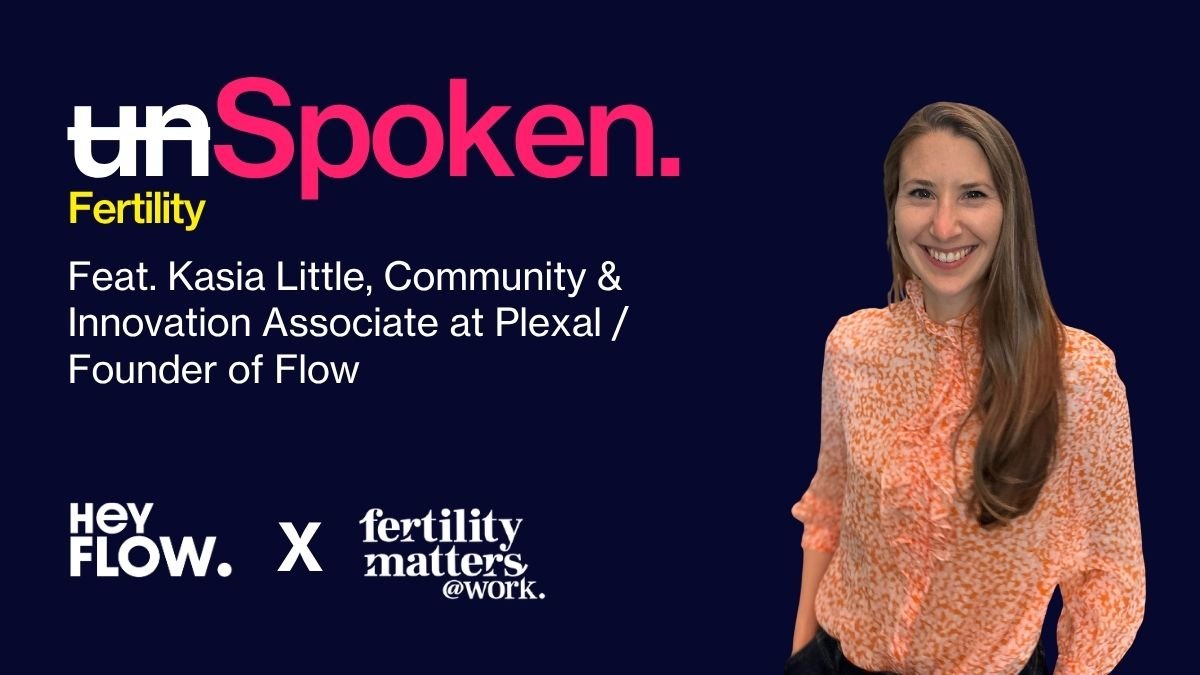
As part of this special edit of HeyFlow’s unSpoken series in collaboration with Fertility Matters at Work, we caught up with Kasia Little, Community & Innovation Associate at Plexal and Founder of Flow (Coaching for people childless by circumstance ready to figure out what’s next).
unSpoken by HeyFlow is a series of interviews about the reproductive health penalty on women’s careers. We’re on a mission to show that reproductive health isn’t just a women’s issue — it’s a business issue.
During Infertility Awareness Month, we are featuring real stories about the impact of fertility on women in the workplace.
Please introduce yourself and tell us a bit about your current role.
Kasia: Hello, I’m Kasia Little - a Community and Innovation Associate at Plexal and Accredited Coach.
After 15 years in marketing and digital transformation - and discovering my life was going to look quite different to what I’d planned - I decided to pivot and explore a ‘portfolio career’.
I now run an innovation accelerator where I help to cultivate the conditions for people to think creatively about problems or challenges through applied innovation methods and workshop facilitation.
Alongside this, I support people navigating the aftermath of childlessness and its impact on identity, confidence and careers through my coaching practice, Flow.
Can you share the fertility journey or fertility-related moment(s) you had to navigate while working?
Kasia: Whilst working at my previous organisation I navigated:
● Trying to conceive
● IVF (ICSI)
● Two IVF losses
● One natural pregnancy loss
● Infertility
How did this fertility experience impact you at work at the time — professionally, emotionally, or practically?
Kasia: My fertility journey lasted four years and, ultimately, culminated in burnout.
It took every ounce of energy I had to keep showing up, acting normal, and performing at my best while carrying one of the heaviest emotional burdens of my life. First through the treatments themselves, then through the grief of our losses, not to mention the loss of identity, purpose, and the future we'd imagined.
So, you could say the impact on my work life was pretty significant.
It wasn't just the never-ending calendar of appointments, scans, procedures, and the inevitable catching up afterwards. It was the fact that fertility occupied my mind every second of every day. No matter what meeting I was in or what project I was working on, it was always there in the background.
I was very open with my employer about what we were going through, and I was fortunate to have a supportive manager who gave me a lot of flexibility during IVF treatment. I hate to think what the experience might have been like without that support.
One thing I don't think gets talked about enough, however, is what happens after unsuccessful IVF and pregnancy loss. On the surface, you're functioning. You're back at work. Life appears to have returned to normal. But inside, it's a very different story.
After our losses, I was so physically and emotionally depleted that no amount of sleep or rest seemed capable of touching the exhaustion. My manager definitely noticed something was wrong and gently checked in, but at the time I didn't have the awareness to call it what it was: grief and depression.
To make matters harder, it felt as though every five minutes there was another pregnancy announcement at work. Having to fight back tears while saying all the "right" things, or being caught off guard by babies and toddlers visiting the office while colleagues were on maternity leave, could be excruciating.
Looking back, I realise I spent years trying to carry an invisible weight while pretending I was fine. Eventually, that takes its toll.
What has been your greatest challenge in sustaining your career during your fertility journey?
Kasia: In many ways, my career was put on hold.
During fertility treatment, I avoided pursuing anything too ambitious. I just needed life to be steady and manageable. The problem is, I'm not really a "steady" kind of person. I'm naturally curious, driven, and always looking for new challenges, so deliberately holding myself back was difficult.
Over time, it also knocked my confidence. I found myself carefully managing the projects I took on and avoiding situations that might add stress to an already overwhelming situation. Instead of pushing forwards, it felt as though I was treading water.
When it eventually became clear that children were unlikely to be part of our future, I threw myself headfirst into work, hobbies, courses, volunteering - anything to try and fill the enormous void that infertility and loss had left behind. But no matter how busy I kept myself, something still felt off.
That's when I started to realise just how much of my career had been shaped by prospective motherhood. I'd prioritised security, stability, salary progression, maternity benefits, and all the practical things that felt important for the family I assumed we would have one day. In the process, I'd sacrificed some of the things that mattered most to me personally.
For the first time, I found myself asking different questions. If I wasn't building my career around becoming a mother, what did I actually want? What felt meaningful? What gave me energy? And was the work I was doing still aligned with that?
Those questions ultimately led me to make a significant career change and take a substantial pay cut to pursue something that felt much more connected to my values and who I wanted to be. It was terrifying. But the cost of staying where I was had become greater than the fear of leaving.
Looking back, one of the biggest challenges wasn't sustaining my career through infertility. It was figuring out how to rebuild it afterwards.
When you were going through this fertility challenge at work, what was the one thing that helped you most — or what do you wish had been in place?
Kasia: I was incredibly fortunate to have a close group of friends among my colleagues who created a safe space for me to talk openly and honestly about what I was going through.
I know that level of openness won't feel right for everyone, but for me, being able to bring my whole self to work was invaluable. It reminded me, and the people around me, that we're all human beings navigating very human experiences behind the scenes, even when we're showing up to meetings, hitting deadlines, and getting on with our jobs.
The more I talked about infertility and pregnancy loss, the more I realised just how common fertility struggles actually are. Keeping these experiences hidden doesn't protect us; it often leaves people feeling isolated at a time when they most need support.
What surprised me most was how many people quietly shared their own stories once the conversation had been opened. Some of my colleagues were navigating fertility challenges of their own, and we were able to support each other in ways that only someone who's been there really can. There was comfort in not having to explain the emotional rollercoaster, the endless waiting, or the heartbreak.
If I could wish for one thing in every workplace, it would be a culture where people feel safe talking about fertility struggles without fear of judgement, awkwardness, or career consequences. Sometimes it only takes one person to speak up before others realise they're not alone. Once that barrier is broken, the floodgates often open.
What do you believe should be the top priority for employers who want to better support employees through fertility journeys or fertility-related challenges?
Kasia: If I had to pick one priority, it would be making fertility support an official part of workplace policy in the same way parental leave is.
The reality is that many people are afraid to ask for support. Fertility struggles, treatment, and pregnancy loss can feel incredibly private, and not everyone wants to have a conversation with HR before they know what help is available. That's why policies should be clearly communicated and easy to access from the outset, ideally during the recruitment process and as part of employee benefits information.
I'd also love to see more education in the workplace. Nothing complicated—just simple guidance, posters, leaflets, or internal resources that help colleagues understand what someone going through fertility treatment or loss might be experiencing, how to offer support, and what not to say.
Small changes can make a huge difference. For example, guidance on sharing pregnancy announcements sensitively, perhaps via email rather than in a meeting, gives people the opportunity to process the news privately. Similarly, giving advance notice if babies or young children will be visiting the office can help someone prepare themselves emotionally rather than being caught off guard.
Ultimately, I don't think most people get it wrong through a lack of compassion. They get it wrong because they don't know what it's like. Employers have a real opportunity to bridge that gap through awareness, education, and policies that acknowledge fertility challenges as a normal part of life that many employees will experience.
At HeyFlow we help organisations remove the blindspots that stall women’s careers, feed the gender pay gap and weaken the leadership pipeline.