
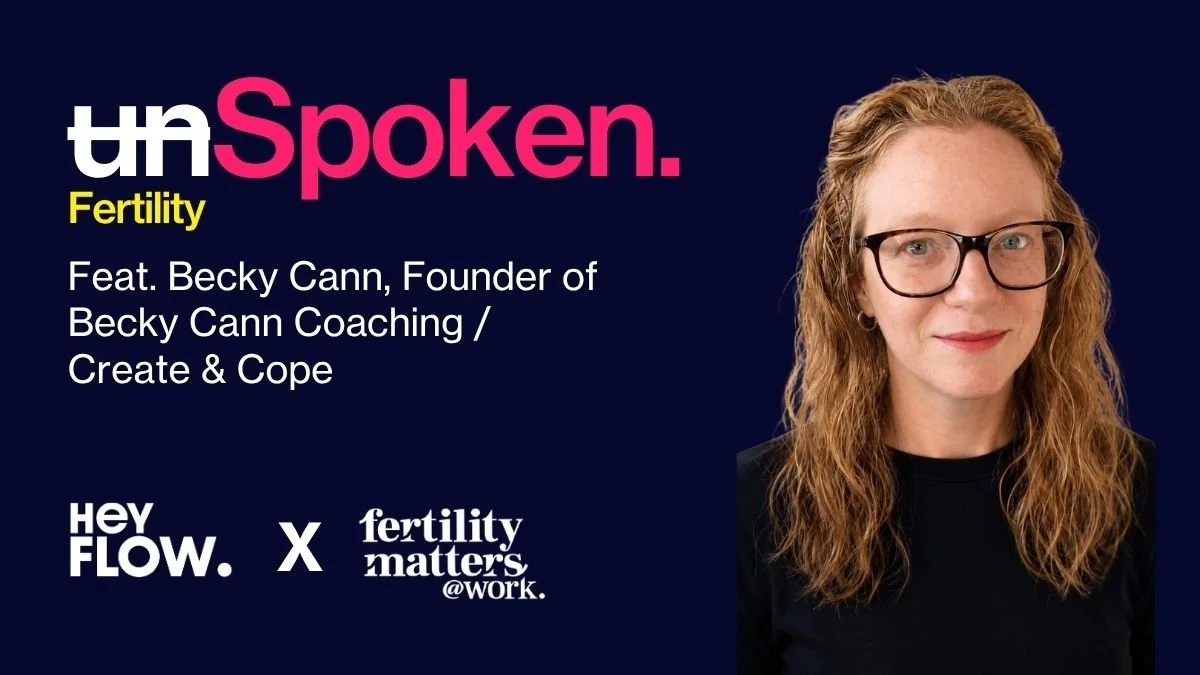
As part of this special edit of HeyFlow’s unSpoken series in collaboration with Fertility Matters at Work, we caught up with Becky Cann, Founder of Becky Cann Coaching / Create & Cope.
unSpoken by HeyFlow is a series of interviews about the reproductive health penalty on women’s careers. We’re on a mission to show that reproductive health isn’t just a women’s issue — it’s a business issue.
During Infertility Awareness Month, we are featuring real stories about the impact of fertility on women in the workplace.
Please introduce yourself and tell us a bit about your current role.
Becky: I'm Becky Cann, founder of Becky Cann Coaching, an emotions-led coaching practice for those experiencing the fertility path. I’m currently a coach-in-training working towards my Level 5 Diploma in Effective Coaching and Mentoring. I’m currently building (early June26) my second business, Create & Cope, which will be a creative and community space for people navigating the fertility journey, I will also be providing employers with fertility related services, from lived experience.
I’ve spent twenty years building a career in marketing, always in-house, across multiple sectors. I’m currently an apprenticeship trainer, specialising in training in marketing and content creator Standards as well as an apprenticeship assessor.
For seven of those years, I was also navigating fertility treatment — Clomid, IUI, IVF, and eventually donor egg conception. I came out the other side with a daughter, who is the joy in my world. But I also came out with a very clear understanding of what people go through within this journey and what they need to get through the weight of it.
Can you share the fertility journey or fertility-related moment(s) you had to navigate while working?
Becky: Where to start!
My journey lasted seven years. Three rounds of Clomid. One round of IUI. One round of IVF on a strong protocol that produced nothing to harvest. And then the conversation I wasn't ready for — that it was highly unlikely I would ever conceive with my own eggs. Our donor egg journey followed - a wait made longer by Covid. Hearing those words was incredibly difficult and finding the right donor, the hardest thing we’ve had to do. I am naturally ginger, so finding her was like a needle in a haystack. We had to come back to the donor bank until we found the right one.
All of this happened while I was working full time across different businesses and management teams, it was exhausting. In the beginning I could hide the appointments using annual leave, at the end I got to the point I wasn’t hiding this experience any longer, I was open with the last employer, who thankfully was super supportive, and we negotiated time off for the treatment. It was a small business, and I appreciated any support he could give, so we agreed a combination of annual and sick leave. Not ideal I know, but we worked on it together which removed a significant amount of pressure. Injections and medication were simpler to do, as I worked at home, I can’t imagine what this is like for those that can’t. A shared experience with my husband who could help on getting things ready.
For a significant period during the journey, I also experienced severe workplace bullying by two female line managers. I was told by a people forum representative that it was the worst case they had seen or supported. That bullying made speaking up about what I was going through at work, impossible. At one point it forced me to pause the fertility treatment entirely. I had to choose between continuing with the career or to continue to build my family. I chose to build the family.
How did this fertility experience impact you at work at the time — professionally, emotionally, or practically?
Becky:
Emotionally: I became very good at performing – okayness. Hiding the hidden depths of the weight of it. The early years involved the tick tock of the body clock, it was incredibly loud. The disappointment of test after test, period after period. The bullying was weighty; it was around 12-18 months of horrendous management changes and conflicting goalposts. I stopped moving forward with tests as I just couldn’t cope with it all.
I developed what I now call the freeze — moments when the fear gripped so hard, I couldn't think, breath, process or function. I was decision fatigued. The anxiety was weighty and gripped me daily. I spent time on the floor; my husband called them floor parties. The workplace bullying happening simultaneously made them harder to recover from. I was a nervous wreck underneath.
Professionally: the bullying — compounded by the emotional weight of treatment — eventually forced me to step back from a senior marketing role I had worked hard to reach. I chose to teach marketing apprenticeships instead. Looking back, this part of my career helped me heal and feel my self-worth again. Giving my trade back in a way that was kinder to my body and my mind. But it was still a professional cost that I paid, the lack of progression and pursuing up the career marketing ladder.
What has been your greatest challenge in sustaining your career during your fertility journey?
Becky: The thing I carried for years was the belief that I thought I should have been able to manage both. Is this a society issue, I wonder? Are humans built for this kind of trauma, no one in my family or immediate friendship group has had to carry this during their lives. I had no terms of reference.
The invisible weight of fertility treatment through a working life is enormous. And it is almost entirely self-managed. I became good at performing, there was shame attached to my failure in my body, I protected myself from having to discuss this and having discomfort with a variety of employers. The greatest challenge was carrying it alone through a workplace that was never designed to hold it. In the early days I hid this, the mid-later stages, I became more open with people I could trust or actually, I just didn’t care what they thought of me, I knew I just wanted to be a mum and that drive was bigger than anything at that point.
When you were going through this fertility challenge at work, what was the one thing that helped you most — or what do you wish had been in place?
Becky: I wish someone had asked the right question at the right time. Not a formal process. Not a policy document. Just a manager who noticed that something was different and found a way to open a door. Someone that I could have trusted as well. The right question, asked with genuine care and without an agenda.
My experience is companies have policies, but managers deliver them in their own way. Flexibility wasn’t applied holistically, it was down to the manager of the team, which made it unfair at times.
A culture that acknowledges ‘life happens’ and that we care, we can help and support whatever way we can. I know they exist because my husband now works for one of those businesses.
What helped most was leaving that environment and finding work that had space in it. Teaching apprentices gave me flexibility, autonomy, and a pace that was survivable alongside treatment. I shouldn't have had to leave to find that. But I did. I don’t have many regrets about this anymore, I did during, but now I’m building my own businesses around this subject, the lived-experience I have and how I want to help others on this path. We didn’t chose it, this is something I did not choose, but it’s something I’ve had to endure and live with. My journey is still not finished, we still have more to go.
What do you believe should be the top priority for employers who want to better support employees through fertility journeys or fertility-related challenges?
Becky: Language before policy.
Most organisations that want to do better reach for a policy first. Policies do matter but how they implement it can be wide ranging. Flexibility for appointments matters. Leave provisions matter. But a policy that nobody knows about, in a culture where nobody feels safe enough to use it, is not support. It is ticking a box.
As an experienced marketing communications marketer, its all about the language. Language makes and breaks workplace cultures. Managers who have the specific words for this experience — who know what to say and what not to say — create the conditions in which a policy can be used. Without that, the policy sits in a handbook, and the employee sits at their desk the morning after a failed cycle, performing fine, carrying something nobody in the building knows about. Training managers with the right language and policy implementation could be the single most impactful thing an employer can do.
At HeyFlow we help organisations remove the blindspots that stall women’s careers, feed the gender pay gap and weaken the leadership pipeline.