
unSpoken - Feat. Dr Divpreet Sacha
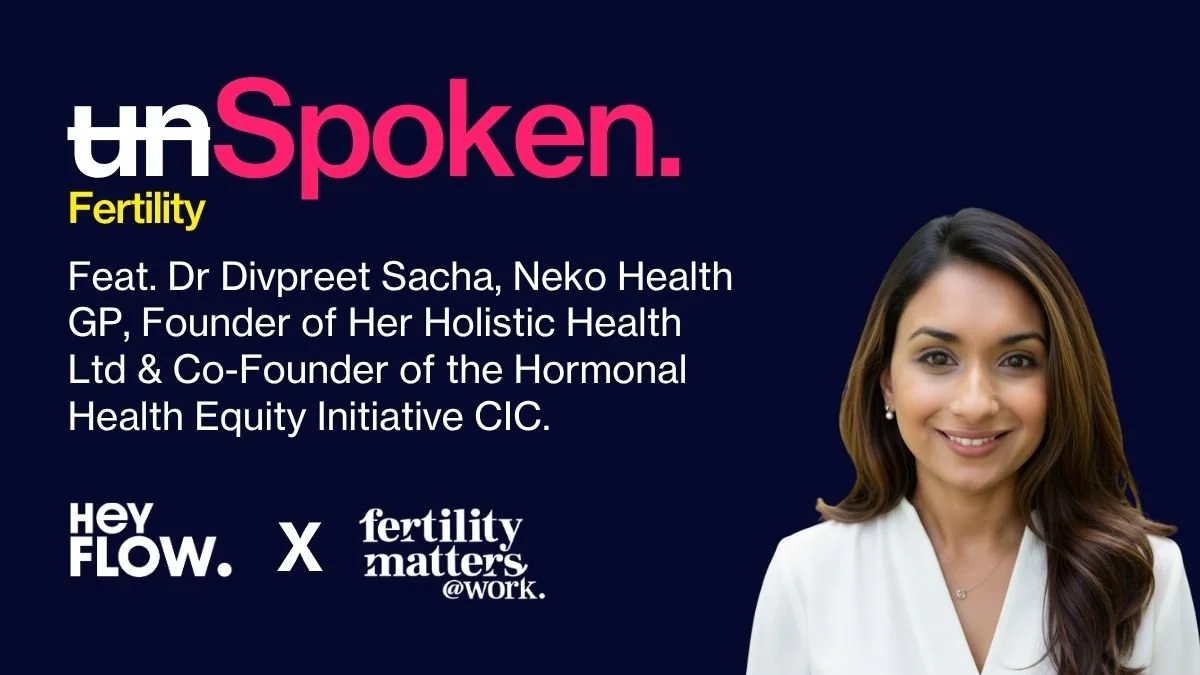
As part of this special edit of HeyFlow’s unSpoken series in collaboration with Fertility Matters at Work, we caught up with Dr Divpreet Sacha, Neko Health GP, Founder of Her Holistic Health Ltd & Co-Founder of the Hormonal Health Equity Initiative CIC.
unSpoken by HeyFlow is a series of interviews about the reproductive health penalty on women’s careers. We’re on a mission to show that reproductive health isn’t just a women’s issue — it’s a business issue.
During Infertility Awareness Month, we are featuring real stories about the impact of fertility on women in the workplace.
Please introduce yourself and tell us a bit about your current role.
Divpreet: I'm Dr Divpreet Sacha: a GP at Neko Health, founder of Her Holistic Health, and co-founder of the Hormonal Health Equity Initiative. My work sits at the intersection of reproductive health, occupational medicine, and women's health equity. But the version of me that's most relevant to this series is an earlier one: a GP trainee who was going through IVF at the same time as seeing patients and trying to hold her career together. I now work in this space in part because I know from the inside what it costs, and how much a toll this journey can take on you.
Can you share the fertility journey or fertility-related moment(s) you had to navigate while working?
Divpreet: I came off the contraceptive pill in my late twenties to start a family, and quickly realised something wasn't right. As a doctor, I could move faster than most. I self-funded private blood tests, confirmed PCOS, and eventually had a laparoscopy for ovarian drilling. What they found wasn't what I expected: stage 3/4 endometriosis, silent, throughout my ovaries and tubes, as well as multiple polyps. I was told natural conception was unlikely. All of this was happening while I was in GP training.
I went through NHS IVF: a process I had to fight to access, pushing repeatedly to get a referral through a remote GP service that kept citing the wrong local guidelines. I had 21 eggs collected, but my first transfer failed. My official test date was my 29th birthday. I already knew: I'd done a private blood test two days earlier, but I had to wait for the clinic's confirmation regardless. I went back to work, but I couldn't stay. The failed cycle had taken more than I'd anticipated. The emotional toll of going through IVF while holding down a clinical training post, showing up for patients, trying to function, caught up with me all at once. I had to take time off. I wasn't coping, and I knew it.
How did this fertility experience impact you at work at the time — professionally, emotionally, or practically?
Divpreet: The emotional impact was the hardest to manage, and the most hidden. I would have patients tell me, almost as an aside, that they'd only had to stop trying so hard and they'd fallen pregnant. I would smile, congratulate them, and move on. Treating patients through their pregnancies and their losses while navigating my own was something I hadn't been prepared for. There's no training for that particular kind of compartmentalisation.
A few weeks after my failed fresh cycle, I was in clinic when a nurse asked me to look at something to do with a new baby. I burst into tears. The immediate thought was: what if I never get to have a baby? She was incredibly kind. I explained what had happened. But that moment captures something I find hard to put into words: carrying this silent weight into every shift, your life feeling on pause, and still having to show up. Still having to function. Until one moment, without warning, you can't.
After that cycle failed, I went to my own GP, was honest, and was signed off sick. I was clinically depressed and anxious. Even then, I felt guilty for leaving.
Practically: my training trust had a policy of two days off for IVF-related procedures. Two days barely covers the monitoring appointments for a single cycle. Professionally: the time off and the mental health strain led to an extension of my training. That's a career cost that rarely gets counted.
What has been your greatest challenge in sustaining your career during your fertility journey?
Divpreet: Invisibility, in every direction.
No one at work knew what I was going through unless I chose to tell them. Fertility treatment doesn't announce itself. You show up, you perform, you manage. Until the moment you can't, and by then people are often surprised, because they had no idea.
The other challenge is one I think about often, partly because I was lucky enough not to face it fully: I knew how to navigate the system. I knew what questions to ask, which GP to go to, what to say to get signed off. I knew the clinical language that makes people take you seriously. Most people don't. And that gap maps, unsurprisingly, onto existing inequalities of class, race, and professional status. That's part of why I do this work.
When you were going through this fertility challenge at work, what was the one thing that helped you most — or what do you wish had been in place?
Divpreet: My supervisor. Without question. She was kind, non-judgmental, and didn't make me justify myself. She took what I said at face value, gave me the space I needed, and made sure I didn't feel like a failure for struggling. That mattered enormously.But I was fortunate. She happened to be the right person, and "happened to be the right person" is not a policy. It's luck.
What I wish had been in place, structurally, is the thing most workplaces still don't have: a genuinely safe way to say "I'm going through fertility treatment" without fearing what happens next to your reputation, your trajectory, your relationships with colleagues. Psychological safety isn't just a culture buzzword. For someone going through this, it's the difference between asking for help early and silently falling apart.
What do you believe should be the top priority for employers who want to better support employees through fertility journeys or fertility-related challenges?
Divpreet: 3 things:
First: psychological safety and policy have to move together. A comprehensive fertility leave policy means nothing if using it feels career-limiting. And a culture of openness without formal structure to back it up leaves people exposed. You need both: policy that actually protects, and leadership that signals day to day that using it is safe. One without the other doesn't work.
Second: healthcare professionals need better training. When someone going through IVF ends up in a GP surgery or occupational health appointment, they need a clinician who understands this isn't just a physical process. I was clinically depressed and anxious, and I was one of the lucky ones: I knew how to describe what I was experiencing. Many people don't, and they leave those appointments with nothing. If clinicians can't recognise and respond to the mental health dimension, the system fails.
Third: connect the dots. Workplace culture, leave policy, and healthcare navigation exist as separate silos. What employees actually need is a joined-up pathway, so that when something goes wrong at 7am on a Tuesday, they know where to go, what to say, and what support is available. That connection has to be built.
At HeyFlow we help organisations remove the blindspots that stall women’s careers, feed the gender pay gap and weaken the leadership pipeline.