
unSpoken - Feat. Francesca Hockham
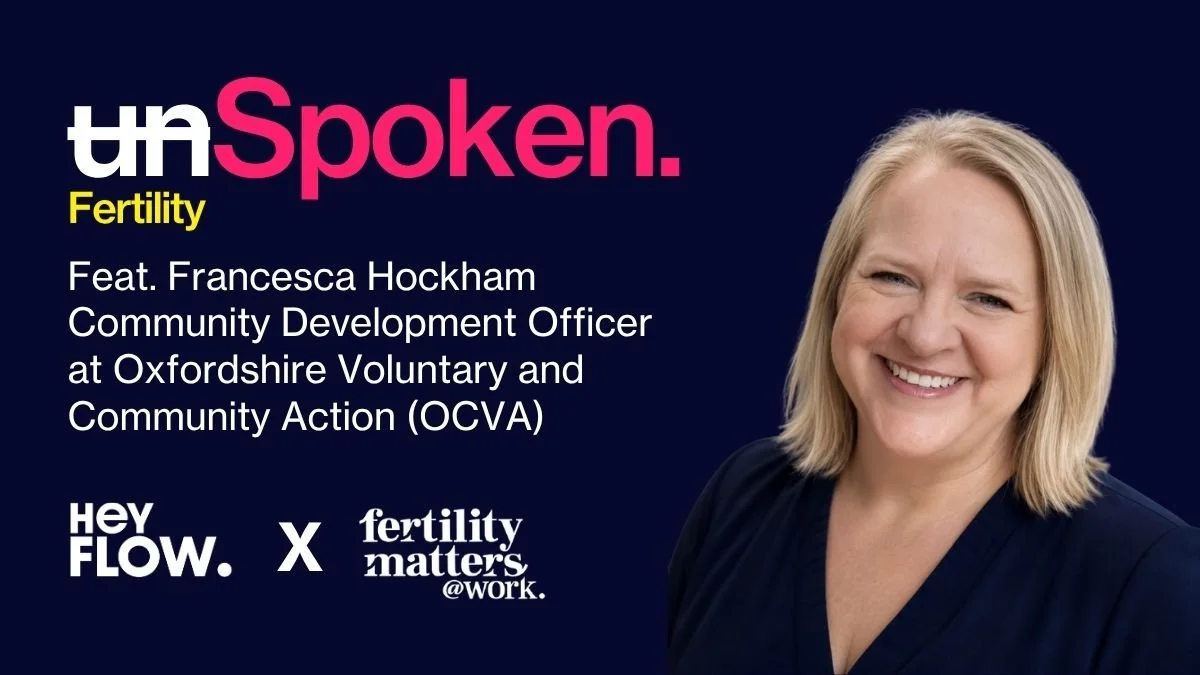
As part of this special edit of HeyFlow’s unSpoken series in collaboration with Fertility Matters at Work, we caught up with Francesca Hockham, Community Development Officer at Oxfordshire Voluntary and Community Action (OCVA)
unSpoken by HeyFlow is a series of interviews about the reproductive health penalty on women’s careers. We’re on a mission to show that reproductive health isn’t just a women’s issue — it’s a business issue.
During Infertility Awareness Month, we are featuring real stories about the impact of fertility on women in the workplace.
Please introduce yourself and tell us a bit about your current role.
Francesca: My name is Francesca, and I have recently joined Oxfordshire Community and Voluntary Action (OCVA) as a Community Development Officer. I have only been in post for two weeks, so I am still settling into the role, getting to know the organisation, and learning more about the communities and voluntary sector groups we support.
Before joining OCVA, I worked in the charity sector for many years, including in senior fundraising roles. During my fertility journey, I was working as a Head of Fundraising for two different charities. Those experiences shaped not only my personal life, but also the way I think about workplace culture, compassion and what it really means to support employees through difficult life events.
I have also been a trustee for Fertility Network UK and currently volunteer for Fertility Action, so this is an issue I care about both personally and professionally. My own experiences, alongside my involvement in the fertility support sector, have made me passionate about improving understanding and support for people navigating fertility challenges at work.
Can you share the fertility journey or fertility-related moment(s) you had to navigate while working?
Francesca: While working, I had to navigate infertility, trying to conceive with fertility drugs, IVF, ovarian drilling, multiple miscarriages, and eventually coming to terms with being childless not by choice.
My fertility journey began while I was working for a local charity. I had joined the organisation around the time I was getting married, and soon afterwards I began fertility treatment and IVF. Because I had recently got married, there was an assumption from some people that having a baby would naturally be the next step. The treatment caused physical side effects, including vomiting and swelling, and people began to assume I was pregnant. That was very painful and uncomfortable, and it was the main reason I decided to share that I was going through fertility treatment, as I wanted to stop the awkward questions and speculation.
Later, when I moved to another charity, I continued to navigate fertility treatment while working. My treatment was successful for a short time, but sadly not permanently. I also experienced a natural miscarriage in 2020 while I was at work. I had not even realised I was pregnant until I lost the pregnancy.
How did this fertility experience impact you at work at the time—professionally, emotionally, or practically?
Francesca: It was incredibly difficult. Professionally, I was trying to hold down senior roles with significant responsibility while managing appointments, treatment cycles, side effects, uncertainty and grief. Fertility treatment is not something that fits neatly around a working day. It can involve scans, medication, procedures and sudden changes to plans, and at the same time you are expected to continue performing as though nothing is happening.
Emotionally, it was exhausting. There was the hope of treatment, the fear it would not work, the physical impact of the medication, and then the grief when treatment failed or when I miscarried. Having people assume I was pregnant because of the side effects made it even harder. It felt very exposing at a time when I already felt vulnerable.
Practically, the lack of flexibility in one role made things much worse. My manager at the local charity was not supportive. I was not allowed to work from home, even though people in other departments were able to do so. I was also asked to postpone my treatment because of a major event and was told I needed to decide what was more important, my career or having a baby. That had a huge impact on me. I was eventually signed off sick, and after returning following failed treatment, I left the charity shortly afterwards.
What has been your greatest challenge in sustaining your career during your fertility journey?
Francesca: The greatest challenge was trying to keep functioning at a senior professional level while privately dealing with repeated loss, uncertainty and trauma. In fundraising, especially at a senior level, there is often pressure to be visible, energetic, resilient and available. But fertility treatment and miscarriage can strip all of that away.
Another major challenge was feeling that I had to prove my commitment to my career at the same time as fighting for the chance to have a family. I should never have been made to feel that it was a choice between my career and a baby. That kind of pressure stays with you.
Being childless not by choice also has a long-term impact. It is not something that simply ends when treatment stops. It affects how you experience workplaces, conversations about family, maternity leave, school holidays, and assumptions about what your life looks like outside work.
When you were going through this, what was the one thing that helped you most — or what do you wish had been in place?
Francesca: The thing that helped most was having a compassionate and flexible manager. In my second charity role, my boss was much more understanding. He allowed me to work different hours and work from home when needed. That flexibility made an enormous difference. It did not take away the pain of what I was going through, but it made work feel more manageable and less hostile.
What I wish had been in place earlier was a clear fertility policy, proper manager training, and a culture where people did not have to disclose deeply personal medical information just to access basic compassion. I wish there had been an understanding that fertility treatment, miscarriage and pregnancy loss are serious health and wellbeing issues, not inconveniences to be worked around only when convenient for the employer.
I also wish there had been recognition that miscarriage requires more than a couple of days to recover from, physically and emotionally. When I miscarried naturally at work in 2020, I was given two days off to recover. I appreciated that my manager responded with kindness, but the reality is that the impact of miscarriage lasts far longer than two days.
What do you believe should be the top priority for employers who want to better support employees through fertility journeys or fertility-related challenges?
Francesca: The top priority should be creating a genuinely compassionate and flexible workplace culture, backed up by clear policies. Employers need to recognise that fertility journeys can include infertility, IVF, pregnancy loss, donor conception, surrogacy, early menopause and being childless not by choice. These experiences are deeply personal, often traumatic, and they do not fit into neat workplace processes.
Employers also need to understand that fertility treatment does not always result in a baby. For some people, the journey ends in loss, failed treatment, or having to come to terms with a life they did not choose. Support should not stop when treatment ends, because the emotional impact can continue long afterwards.
At a minimum, employers should have a fertility and pregnancy loss policy, offer flexibility for appointments and recovery, train managers to respond sensitively, and make sure employees are not penalised for needing support. No one should be asked to choose between their career and the possibility of having a child.
The most important thing is that employees feel believed, respected and supported without having to fight for understanding at the worst moments of their lives.
At HeyFlow we help organisations remove the blindspots that stall women’s careers, feed the gender pay gap and weaken the leadership pipeline.