
unSpoken - Feat. Cristina Tiberian
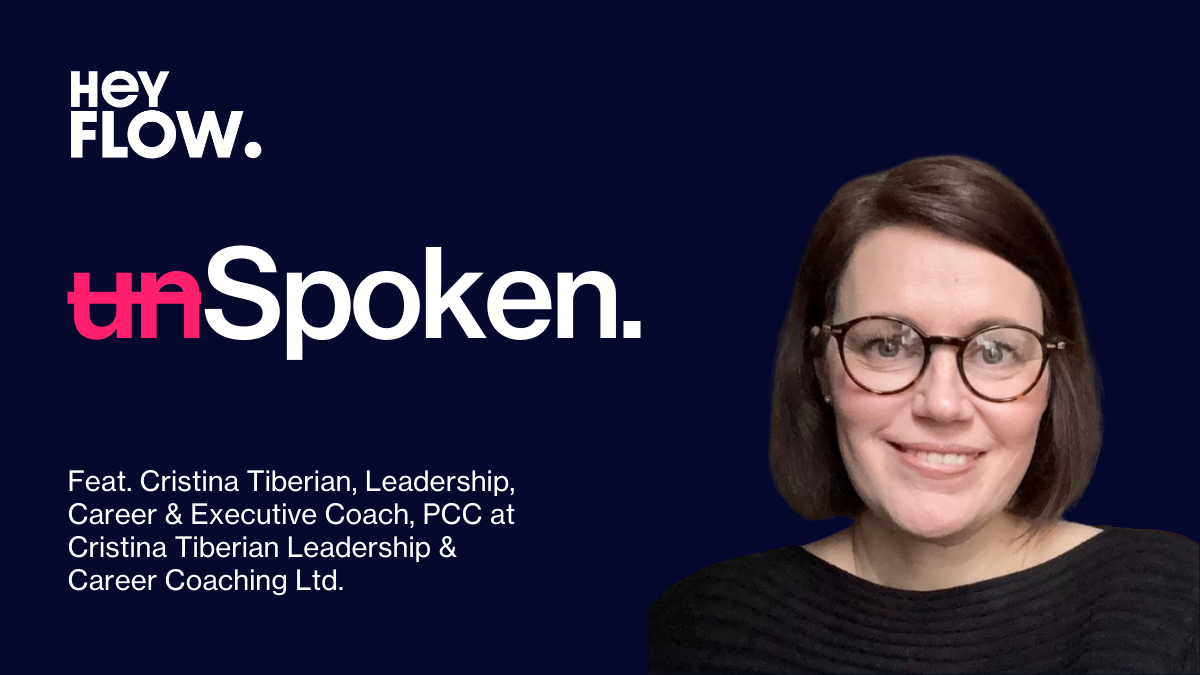
As part of the ‘unSpoken’ series, we caught up with Cristina Tiberian, Leadership, Career & Executive Coach, PCC at Cristina Tiberian Leadership & Career Coaching Ltd.
unSpoken by HeyFlow is a series of interviews about the reproductive health penalty on women’s careers. We’re on a mission to show that reproductive health isn’t just a women’s issue — it’s a business issue.
This series shines a light on the hidden career barriers created by reproductive health and their role in the workplace gender gap. Through real stories from real people, we aim to break taboos and drive change for a more inclusive future of work.
HeyFlow: Please introduce yourself and tell us a bit about your current role.
Cristina: I’m a trauma-informed Leadership, Career and Executive Coach, credentialed by the International Coaching Federation. I run a values-driven coaching practice, supporting leaders and organisations in the charity and public sectors, as well as ethical companies, B Corps and social enterprises.
Before becoming a professional coach, I spent over a decade working in the charity sector, initially in marketing and communications and later in fundraising roles. I left my last senior role in 2020 after a period of burnout and I retrained as a coach. I wanted to work at the intersection of leadership, wellbeing and systemic change - particularly for women navigating change, workplace trauma, intersectionality, caregiving or invisible labour at work.
HeyFlow: Can you share the reproductive life moment(s) you had to navigate while working? Did these experiences impact you at work at the time? If so, how?
Cristina: I became a parent later in life — I had my children at 36 and 42 — and both pregnancies happened while I was working full time in target-driven roles. Between my two children, I also experienced two early miscarriages. I took only a couple of days off after each one. At the time, I didn’t feel I had permission to slow down, to be visibly impacted, or to take the space my body and nervous system needed.
Both of my pregnancies were high risk. This was pre-pandemic, when flexible working was the exception rather than the norm, and I was commuting three hours door-to-door from Surrey to London four days out of five. I felt as though I was constantly asking for special treatment just to meet basic physical needs. During my second high-risk pregnancy, I had numerous appointments which added another layer of stress alongside the pressure to remain professionally “reliable”. Eventually, I was placed on bed rest from 20 weeks until birth and had to stop working. Again, more guilt!
Returning to work after maternity leave was where things truly unravelled. I came back on compressed hours — effectively working close to full time in four days — so I could spend one day a week with my baby daughter. I was in a high-pressure, target-driven senior role, caring for a baby who wasn’t sleeping for more than three hours at a time. Unbeknownst to me then, I was also navigating undiagnosed ADHD and the onset of perimenopause. All of these really took their toll on me.
Within nine months, I was completely burned out.
Looking back now, with the perspective I have as a trauma-informed leadership coach, I can see that what was missing wasn’t resilience or professionalism on my part — it was trauma-informed leadership around me. There was no curiosity about capacity, no shared language for overwhelm, and no psychological safety to say “this isn’t sustainable” without fear of judgement or career damage. I masked harder, pushed through the exhaustion, and relied on coping strategies that were already under strain — until my body and mind could no longer carry the load.
I didn’t need a line manager who had lived my experience, but one who could listen without judgement, respond with humanity, and adapt the system rather than asking me to contort myself further.
HeyFlow: What has been your greatest challenge in sustaining your career during these moments?
Cristina: The greatest challenge was the pressure — both internal and external — to “do it all”. I’ve since realised that you cannot parent as if you’re not working, and work as if you’re not parenting. The system may reward that illusion for a while, but the cost eventually comes due.
For me, that cost was burnout — and it didn’t just affect my career. It affected my health, my family, and my sense of self.
I also struggled with a profound lack of belonging. I worked in environments where targets were prioritised over people, and where working mothers were quietly expected to adapt themselves to structures that hadn’t been designed with them in mind.
For instance, the weekly department meeting was scheduled at 4pm. My working hours were 8am to 4pm because I had to get back to Surrey to collect my child from nursery or face fines. Every week involved an eight-minute sprint from the office to the train station, often barely making it onto the train. So of course, I missed those meetings every time which meant that I was less visible and felt like I didn’t belong.
Pre-pandemic, being physically present in the office was equated with commitment. It’s starting to become that way again now. I have several coaching clients at the moment who are working mothers and they share stories regularly about colleagues who got promoted because they were “seen more”, while they had been penalised for having boundaries shaped by caregiving. This is how the motherhood penalty shows up long before it appears in pay or promotion data. As a coach I hear about it first!
HeyFlow: When you were going through this reproductive health challenge at work, what one thing helped you — or what do you wish had been in place to support you?
Cristina: I wish I’d had access to return-from-maternity coaching support.
Returning to work after maternity leave isn’t a simple resumption of a previous role - it’s an identity, cognitive and physiological transition. Coaching at that point would have given me a confidential, safe space to process the shift, rebuild confidence, renegotiate boundaries, re-assess my values, and challenge the internalised pressure to prove commitment by over-functioning.
I also wish my line manager had received training in how to support maternity returners - not policies or checklists, but real understanding of what this transition does to a person and how to lead with empathy, curiosity and psychological safety.
HeyFlow: What do you feel should be the top priority for employers who want to better support employees through reproductive health challenges?
Cristina:At the heart of this should be the recognition that reproductive health and caregiving are part of working life. When workplaces are designed around an “ideal worker” with no caring responsibilities, the result is the motherhood penalty: a systemic disadvantage in pay, progression and security that has nothing to do with capability.
It is deeply baked into cultures and structures that reward visibility, availability and uninterrupted careers. To address this, employers need to move beyond policy and focus on how people are led, particularly at transition points.
In my view, there are changes that most organisations could make such as:
structured return-from-maternity coaching, to support confidence, agency and sustainable performance
co-created, human-centred return-to-work plans
flexible working as a default, not a personal accommodation
training managers in trauma-informed leadership, so they can lead with empathy, curiosity and nervous-system awareness
normalising parenting out loud, and resisting “protective sidelining” that removes visibility or responsibility under the guise of support
I dream of a working world in which all leaders are trauma-informed. And in this context, I mean that they understand how life events like pregnancy, miscarriage, birth, sleep deprivation and return from leave affect capacity - and they create conditions where people can do their best work without self-silencing or burning out.
This is why trauma-informed leadership sits at the heart of my coaching work today. I’ve seen — personally and professionally — how much difference it makes when managers are equipped to lead humans, not just roles.
At HeyFlow we help organisations remove the blindspots that stall women’s careers, feed the gender pay gap and weaken the leadership pipeline.