
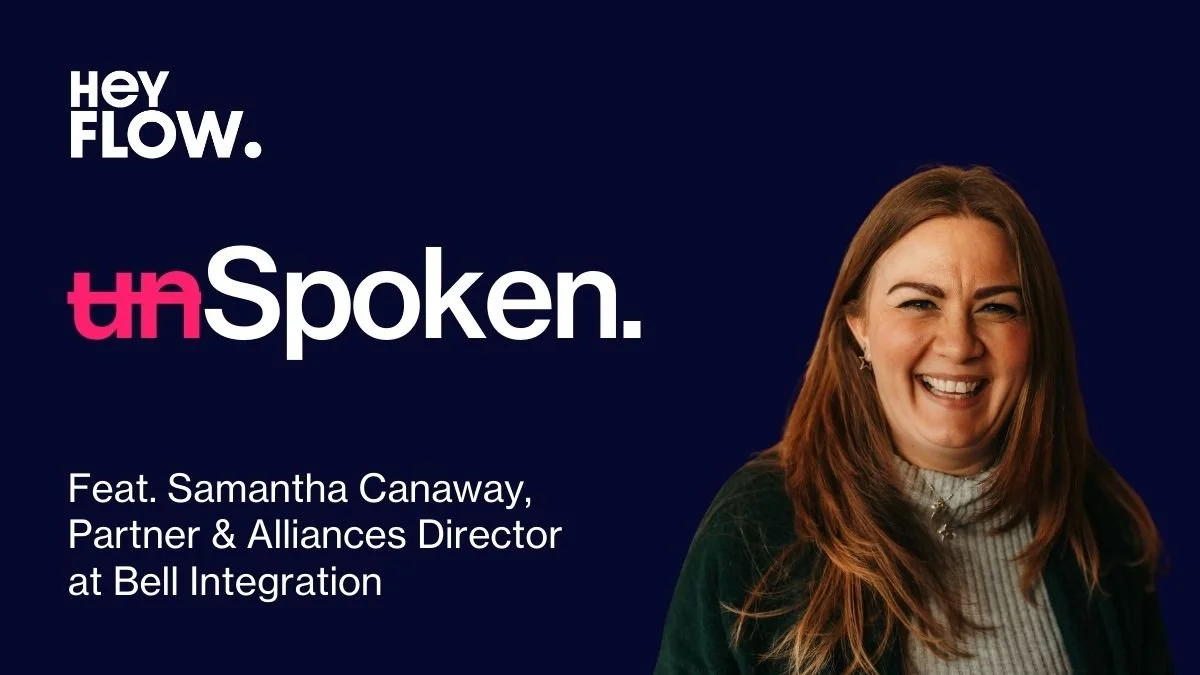
As part of the ‘unSpoken’ series, we caught up with Samantha Canaway, Partner & Alliances Director at Bell Integration.
unSpoken by HeyFlow is a series of interviews about the reproductive health penalty on women’s careers. We’re on a mission to show that reproductive health isn’t just a women’s issue — it’s a business issue.
This series shines a light on the hidden career barriers created by reproductive health and their role in the workplace gender gap. Through real stories from real people, we aim to break taboos and drive change for a more inclusive future of work.
HeyFlow: Please introduce yourself and tell us a bit about your current role.
Samantha: I’m Sam, and I’m the Partner & Alliances Director at Bell Integration, where I lead our teams of procurement, order management, supplier and vendor management creating a cohesive partner ecosystem. My role requires me to work closely across the business globally on supporting initiatives that drive customer value and organisational growth. I also lead our Mental Health First Aid Team and Initiative within Bell and form part of our Senior Leadership Team. Outside of my corporate role, I’m deeply passionate about women’s health, fertility awareness, mental health, and creating inclusive workplaces.
I’m also the founder of a brand I built- Rain 2 Rainbow, a community and jewellery brand inspired by my own fertility journey, created to provide hope, connection, and comfort to others navigating infertility, IVF, and baby loss. Through my advocacy work, speaking engagements, and charitable engagements (including raising funds and awareness for Tommy’s charity where profits each year are donated to their cause from my brand) I use my lived experience to champion better understanding, education, and compassion in workplaces and the wider fertility communities.
HeyFlow: Can you share the reproductive life moment(s) you had to navigate while working?
Samantha: My journey to motherhood was far from straightforward. After 18 months of trying to conceive naturally, my husband and I were diagnosed with unexplained infertility. This began an 8 years cycle of IVF treatments, failed cycles, heartbreaking setbacks, and the emotional, physical, and financial strain that comes with it.
I experienced both an early pregnancy and then a long, drawn-out miscarriage that lasted weeks, leading me to become extremely unwell requiring medical intervention, this was all while balancing the realities of a demanding fast paced job. My role at the time required me to be on many calls, attended meetings, added with lots of travelling, all whilst trying to maintain a level of professionalism and meet both internal and external expectations with my network, juggling this with a constant cycle of appointments, injections, scans, uncertainty and at many times periods of extreme grief. However, I truly believe it is these lived experiences that have ultimately shaped the person I am today in both my personal and professional life, it has been an extreme life changing cycle.
HeyFlow: Did this experience impact you at work at the time? If so, how?
Samantha: Absolutely, in ways I didn't fully understand until much later. Fertility treatment is all-consuming. It affected my concentration, my energy, my confidence, and at times my sense of identity. There were days I was physically exhausted from medication, emotionally drained from bad news, or trying to hide the aftermath of another setback.
I often felt the societal pressure that I had to “push through”, show up, keep performing, and not let anyone down, I think that’s a common trait we as women often feel, even when I was carrying unimaginable sadness. At times I worked through pain or left the office in tears after receiving difficult updates, but I hid that and never let anyone see it, quietly struggling with it alone. This dual burden of being a high-performing professional and someone silently breaking inside is something many people underestimate.
HeyFlow: What has been your greatest challenge in sustaining your career during these moments?
Samantha: Two things stand out:
The emotional labour of silence.
Infertility is still taboo. I didn’t always feel I could share what was happening. Carrying that invisible weight and trying to remain composed was one of the hardest parts. Particularly as back then I worked in a highly male dominated environment, I had no expectation that they could or would understand what I was going through and facing.
2. Navigating unpredictability while expected to be consistently “on”.
Treatments change daily, emergencies arise, and cycles fail without warning. Balancing that with deadlines, responsibility, and leadership expectations was incredibly challenging.
Despite these barriers, my determination to continue progressing in my career, while staying true to who I am, became a driving force. My journey ultimately fuelled my advocacy for women’s health and inclusive workplace cultures.
HeyFlow: When you were going through this reproductive health challenge at work, what one thing helped you—or what do you wish had been in place to support you?
Samantha: What helped most was compassion and flexibility, the moments when a manager or colleague quietly showed understanding without pressing for details. I was incredibly lucky that I had been in my organisation a great deal of time, I have earnt respect, value and reputation that meant I was supported extremely well by those around me, my boss at the time was and still is an incredible male ally and mentor to me.
But what I wish had existed was:
A clear, formal workplace policy on fertility treatment
A psychologically safe environment to talk about it (its why I lead our MHFA initiative, given colleagues a safe space to talk to someone about anything they need to is incredibly important, it is not just an extreme focus on Mental Health, but about wellbeing)
Leaders trained to understand the emotional toll of IVF, Fertility challenges and loss
More flexibility for last minute appointments and recovery time
It is why I now advocate so strongly for education and empathy in organisations. No one should have to choose between their fertility and their career, as women we are often made to feel we can and should have it all, the reality is I think we can, but it just has to be recognised it can’t all be at once.
HeyFlow: What do you feel should be the top priority for employers who want to better support employees through reproductive health challenges?
Samantha: The top priority should be creating an environment where reproductive health is recognised, understood, and properly supported, not treated as a private personal burden employees must manage alone, it’s the acceptance and support of being our whole selves no matter the environment and that is so important at work and what I believe is the true essence is driving a thriving work place as it creates space for so much possibility, promise and gaining the best from people.
1. Education & Awareness
Train leaders to understand IVF, infertility, miscarriage, menopause, and reproductive health so they can respond with empathy and informed support, many of these are unavoidable life cycles that shouldn’t be ignored but catered for.
2. Supportive, flexible policies
Time off for appointments, emotional recovery, and medical procedures should be standard, not something individuals have to negotiate.
3. Psychological safety
Create a culture where people feel safe to disclose without fear of judgment, career impact, or stigma.
4. Normalise the conversation
The more we talk openly, the more we remove shame and isolation, empowering individuals to focus on their wellbeing without sacrificing career progression.
These changes don’t just support individuals they drive inclusion, retention, trust, and organisational resilience.
At HeyFlow we help organisations remove the blindspots that stall women’s careers, feed the gender pay gap and weaken the leadership pipeline.