
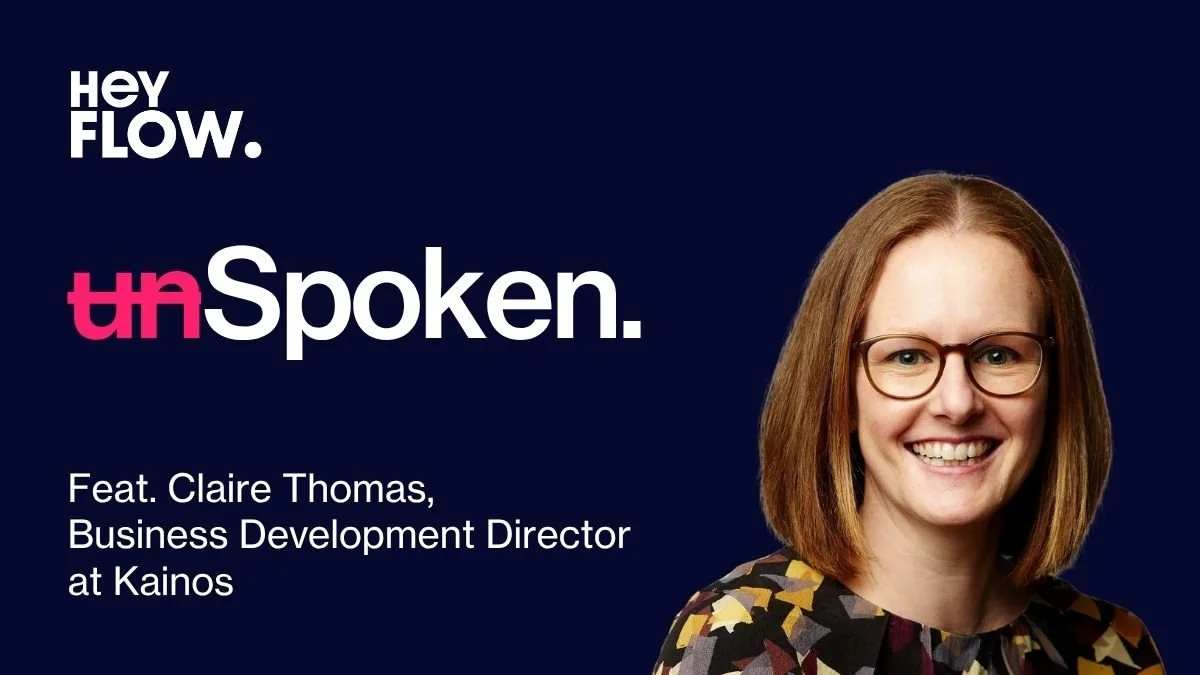
As part of the ‘unSpoken’ series, we caught up with Claire Thomas, Business Development Director at Kainos.
unSpoken by HeyFlow is a series of interviews about the reproductive health penalty on women’s careers. We’re on a mission to show that reproductive health isn’t just a women’s issue — it’s a business issue.
This series shines a light on the hidden career barriers created by reproductive health and their role in the workplace gender gap. Through real stories from real people, we aim to break taboos and drive change for a more inclusive future of work.
HeyFlow: Please introduce yourself and tell us a bit about your current role.
Claire: I’m Claire, advocate for women’s equality, equal parenting and better support for neurodivergent children and their parents. I believe in the power of women using their voice to share stories, to normalise our experiences, to show we are not alone and to change systems that don’t serve us. I’m a mother to two boys, age 6 and 4, having become a mother after two years of unexplained infertility, a late diagnosis of polycystic ovary syndrome, and fertility treatment. I am currently in the early stages of peri-menopause at 42 – don’t believe whoever tells you it starts at 50!
I joined Kainos a year ago to work in public sector sales. Kainos is a Northern Irish digital native company that most people have never heard of whilst almost every UK citizen uses technology we helped to build – the digital passport service, the NHS app, MOT reminders, theory test services, Covid test and trace, and services that support repatriation efforts in times of conflict.
HeyFlow: Can you share the reproductive life moment(s) you had to navigate while working?
Claire: The journey from deciding I wanted to have children, to navigating the process of “unexplained” infertility, to getting a PCOS diagnosis, to taking fertility treatment and becoming a mother months before Covid, and now experiencing peri-menopause have all happened whilst I worked full time.
HeyFlow: Did this experience impact you at work at the time? If so, how?
Claire: Absolutely. Before trying for children, I had no idea how common infertility (1 in 6 couples) and miscarriage (1 in 4 pregnancies) were. Many of us spend our teenage years and 20s trying not to get pregnant, and then when you are ready to be pregnant, it can be really hard. The unrealistic expectation that getting pregnant would be straightforward, combined with the fact that I had never heard anyone talking about personal reproductive health experiences at work created a very lonely environment. I stayed silent, whilst crying every month when my period came, beating myself up that it must be something I was doing “wrong”, blaming myself for not trying earlier (I was in my mid-30s), and piling on more pressure by working even harder to prove I was good at something. I was worried that if people knew I wanted a baby, I would not be given opportunities or promotions. This pressure led to frequent exhaustion and eventually overwhelm. Then each time I made the choice to trust someone with what was happening privately, I was met with kindness and humanity first.
At one point, I was booked on a trip to Vietnam when the acupuncturist I saw to help with fertility said, “Don’t they have Zika in Vietnam?”. Oh shit, I thought, as I called up the VP of my department to tell him I couldn’t go, only to receive complete understanding, no question about the money wasted on travel and no invasive questions at all.
Becoming a mum made me even more determined to succeed in my roles and progress my career – if anything my ambition grew now I had children to provide for. I was promoted when I was pregnant the first time, and then came back from my second maternity leave into a totally new role and another promotion.
Going through peri-menopause has been very different to hiding my infertility. Prior to HRT, it was affecting my ability to focus and my energy levels. This time, I made a choice to share what was happening with my manager very openly and that I was navigating the process with my GP.
I now openly talk about my experiences with others in the hope that we can normalise conversations about reproductive health and how it can impact our colleagues. I don’t want anyone to feel as alone as I did in the past.
HeyFlow: What has been your greatest challenge in sustaining your career during these moments?
Claire: Maintaining energy levels to parent two boys, protect my own wellbeing and show up at work how I want to. “Women can have it all” is a fallacy – code for “you should be able to do it all”. You can have it all for a short period, then something breaks. You have to fiercely set and protect boundaries, say no to things that aren’t yours (women get so many voluntary labour requests!), and protect rest like it is sacred. Our systems need major updates to properly value the contributions parents make to our economy through unpaid work and support the many changes we’ve seen to the shape of families / work in recent decades.
I have also had to quieten the voice in my head that has said, “You can’t accept that role, you’re 8 weeks pregnant and going on leave in 7 months”, and, “Maybe you shouldn’t apply for that promotion whilst on maternity leave”. I could have held myself back so many times to fit around rules I made up in my head, and I’m thankful I’ve had good counsel to keep pushing ahead if it makes sense for me.
HeyFlow: When you were going through this reproductive health challenge at work, what one thing helped you—or what do you wish had been in place to support you?
Claire: The biggest help was having trusted people to talk to about what was happening and what support I needed. It is definitely easier to talk with hindsight, but I wish I had shared what was happening for me earlier. I wish that there had been an environment where there was more open conversation about life and its challenges, including reproductive health, so I didn’t feel I had to stay silent. I wish I had rested more, rather than pile on more pressure. And I wish we had better mandatory support for fertility / infertility in the workplace – it can take a lot of time for appointments, consultations and intervention – not sharing these with your employer if you feel that is the only choice can add to an already stressful situation.
HeyFlow: What do you feel should be the top priority for employers who want to better support employees through reproductive health challenges?
Claire: Equipping managers with the tools needed to have a supportive conversation with employees. You don’t need lived experience to be able to empathise, you do need to care, ask informed questions on what support they may need, and listen well. I highly recommend HeyFlow’s reproductive health survey and manager training support to upskill people managers of all genders.
At HeyFlow we help organisations remove the blindspots that stall women’s careers, feed the gender pay gap and weaken the leadership pipeline.