
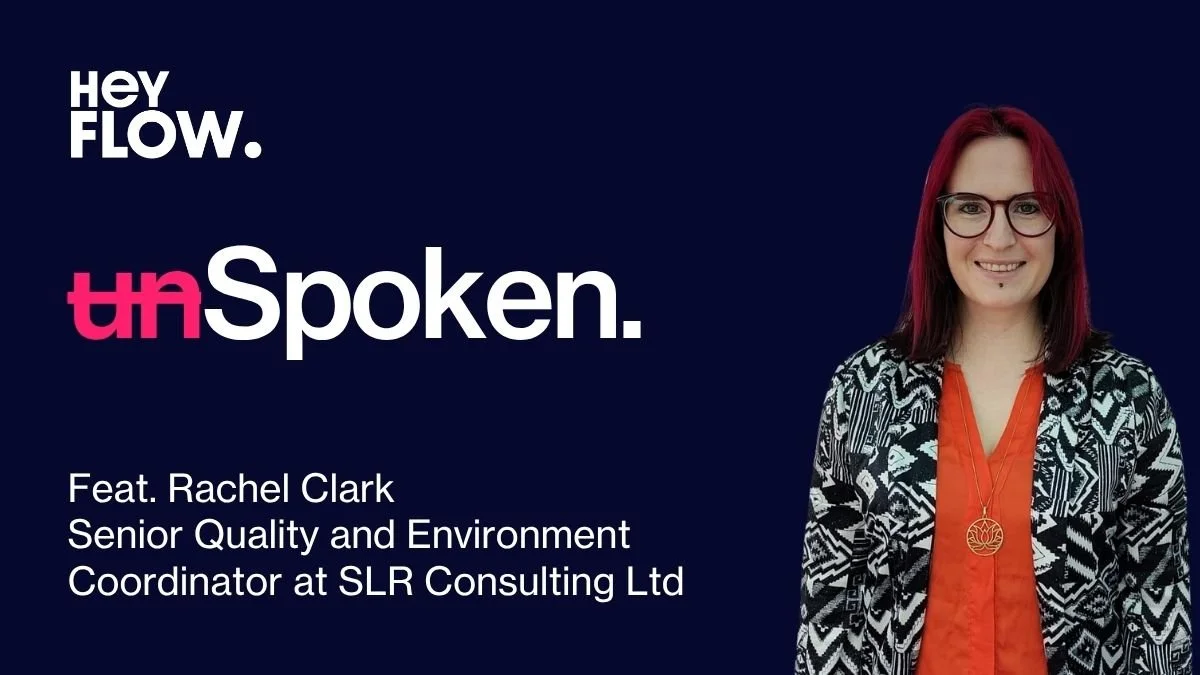
As part of the ‘unSpoken’ series, we caught up with Rachel Clark, Senior Quality and Environment Coordinator at SLR Consulting Ltd.
unSpoken by HeyFlow is a series of interviews about the reproductive health penalty on women’s careers. We’re on a mission to show that reproductive health isn’t just a women’s issue — it’s a business issue.
This series shines a light on the hidden career barriers created by reproductive health and their role in the workplace gender gap. Through real stories from real people, we aim to break taboos and drive change for a more inclusive future of work.
HeyFlow: Please introduce yourself and tell us a bit about your current role.
Rachel: My name is Rachel and I work in the Quality and Environment department of an environmental consultancy as a Senior Coordinator. I am also the co-host of a sustainability employee network and a UK representative on the Culture and Inclusion committee. I love how varied my role is and that I’m part of driving positive change within the workplace. Being part of the culture and inclusion committee has really given me a platform to help change workplace culture in a way that suits and benefits all. I have recently co-hosted a webinar with Endometriosis UK for the Gender and Inclusion employee network on endometriosis awareness in the workplace. I’m currently working on writing a menstrual health policy and am researching an accompanying training programme for menstrual health champions to be launched at the same time as the policy.
I’m proud to be part of an organisation that wants to encourage conversation and spread awareness about women’s health and wellbeing in the workplace.
Outside of work I am deeply passionate about women’s health, equal rights and mental health and regularly host women’s circles. These circles are a safe and inclusive space where we gather and share feelings and stories and express ourselves freely in what I strive to be a continuously supportive and nurturing environment.
HeyFlow: Can you share the reproductive life moment(s) you had to navigate while working?
Rachel: I have had to cope with various menstrual health challenges during my working life. I’d say the biggest challenge has been navigating endometriosis. Currently, I can only officially name it a ‘pelvic pain condition’ but I am 90% sure I have endometriosis due to the symptoms I experience and because of the findings so far from various hospital procedures. As it frustratingly takes on average around nine years for a formal diagnosis, currently I don’t have one yet, but I feel confident referring to my condition as endometriosis regardless of this.
HeyFlow: Did this experience impact you at work at the time? If so, how?
Rachel: This condition has impacted my working life a great deal, predominantly because of the amount of pain I have been in. I’ve had to take time off from work, I have to take strong painkillers regularly that can make me feel quite tired and drowsy and I work from home significantly more than I used to, especially at times when I get endometriosis flare ups. The load on my mental health is quite significant too. I am in pain for over half of the month at various points in my menstrual cycle, not just when I’m on my period, and when I’m in pain to such a degree for that long consistently every month, it takes its toll. At times when I am on my period, I can only describe it as the worst period pain you can think of, times ten. At times it is difficult to concentrate when I am experiencing so much pain and it’s difficult to stay enthusiastic, which is an unusual shift in behaviour for me as I see myself as a naturally optimistic person.
HeyFlow: What has been your greatest challenge in sustaining your career during these moments?
Rachel: Figuring out how to navigate and adjust to this new version of myself, both inside and outside of work. It was a real adjustment accepting that my lifestyle, my approach to work and the amount I can push myself had to change. This transition has been a blessing in a way because I realised I was doing too much and needed to slow down but this change has obviously been quite upsetting too.
I now know that travelling, illness, tiredness and stress are the biggest causes of endometriosis flare ups for me so I need to make sure I maintain good sleep hygiene, I don’t travel too much for work, I try to stay as healthy as possible (with the occasional cake binge of course) and I keep my stress levels down by organising my workload efficiently and practicing self-care daily.
Another significant challenge for me was admitting that I needed support and asking for a more flexible approach to working patterns. For me there’s a certain amount of pride in the workplace and I felt initially that by admitting that I needed reasonable adjustments at work I was somehow inferior to my colleagues or not good enough. I now know that this opinion reflected a very much patriarchal, outdated view of the workplace and in fact there is nothing inferior about asking for support or understanding when I need it.
HeyFlow: When you were going through this reproductive health challenge at work, what one thing helped you—or what do you wish had been in place to support you?
Rachel: I am fortunate that my current line manager is very understanding and empathetic, but I unfortunately can’t say everyone I have communicated to about my condition has been as understanding. I think there is still a taboo in our society where, if something isn’t visible then it isn’t completely believed or understood. In the past I was still expected to travel to and from the office even though I was in a considerable amount of pain and there was a feeling that I wasn’t taken seriously because of the lack of a formal diagnosis or having a condition that was visible to others.
I feel like having the confidence to be transparent and able to talk about my condition to anyone I work with is really important, but sadly it’s not the reality. Unfortunately, there is still taboo, stigma, miseducation and unawareness about menstrual health conditions. In today’s society, especially when we now know that endometriosis is as common as asthma and is the second most common gynaecological condition in the UK, I should feel comfortable taking about it like any other health condition. Instead, I need to hide my condition and its symptoms for fear of how others might react.
I do however work in a supportive small team of people who I can confide in about my condition, which is important to me as it gives me the confidence to show up as I am and to not feel like I’m concealing my feelings and symptoms. I don’t think I would work anywhere else now that had people who showed any less compassion, empathy or understanding for menstrual health conditions like mine.
HeyFlow: What do you feel should be the top priority for employers who want to better support employees through reproductive health challenges?
Rachel: A place of work should be somewhere we can normalise the discussion of reproductive health challenges without fear of judgement or criticism. The top priority for employers should be to proudly show compassion, understanding and awareness around menstrual health. It is the employer’s responsibility to create a psychologically safe environment where people can speak up without fear of judgment or the minimisation of their feelings and symptoms. Employers should provide training on menstrual health and have policies in place to support spreading awareness so that stigmas are dispelled and everyone can feel more confident in and comfortable with speaking about menstrual health conditions. These policies can help to guide people who may not feel confident in talking about their symptoms and for asking for support but also to those who should support their colleagues experiencing those symptoms. A policy is obviously not enough though, there also needs to be the fostering of a supportive workplace culture with education and awareness spread in formats such as relevant training sessions, webinars, networks and support groups.
I think it is also important for employers to actively support employee’s mental health and have benefits in place that reflect that support.
Employers should encourage those who have knowledge and understanding of menstrual health to safely come forward and show support for others in the workplace who might need it by providing opportunities such as mental health first aiders and menopause and menstrual health champions.
At HeyFlow we help organisations remove the blindspots that stall women’s careers, feed the gender pay gap and weaken the leadership pipeline.